


How MESSOUD works
A watch that follows the heavens, not the network.
A MESSOUD is not a smartwatch with an Islamic veneer. It is a mechanism, a calculation, and a tradition, built from the first second for the Muslim who takes their deen seriously. Below, we explain how it works, and why.

How the watch knows when Fajr begins
The prayer times were not invented by humans. They are connected by Allah to the position of the sun: twilight before sunrise for Fajr, the sun's zenith for Dhuhr, the shadow after midday for Asr, sunset for Maghrib, and the full fall of night for Isha. The time of prayer is not a clock setting. It is a celestial position.
MESSOUD follows that heaven. The watch contains an astronomical core that calculates the sun's position every day based on your location, date, and latitude. No Wi-Fi needed, no server, no app that needs to check in somewhere.
The same mathematics Al-Battani used in the ninth century to determine Damascus's prayer times, and which Al-Biruni later applied to cities from Cordoba to Samarkand, that same mathematics is now in a mechanism on your wrist. Not as an ornament, but as a core.
That's why MESSOUD works in the desert, on a plane, in a village without reception. The heavens don't need a subscription.

How it follows your madhhab
Islam is one, but fiqh is rich. The four Sunni madhhabs: Hanafi, Maliki, Shafi'i, and Hanbali, all operate from the same Quran and the same Sunnah, yet arrive at different rulings on points of detail. For the Asr prayer, for example: the Hanafi school calculates the time when the shadow of an object is twice its own length, while the other three schools calculate the time at one time the shadow length.
Both are valid. Both are well-reasoned. And your prayer deserves the time that the fiqh has stipulated for it.
MESSOUD recognizes that. In the settings menu, you choose the calculation method that your scholars follow: Muslim World League, Umm al-Qura, ISNA, Egyptian method, and more. For Asr, you set the shadow rule according to your madhhab.
From that moment on, the watch calculates as your imam would. No average, no compromise, no Western algorithm imposing a one-size-fits-all approach.
No other watch on the market does this. It's not a feature. It's adab towards the fiqh.
How it indicates the Qibla
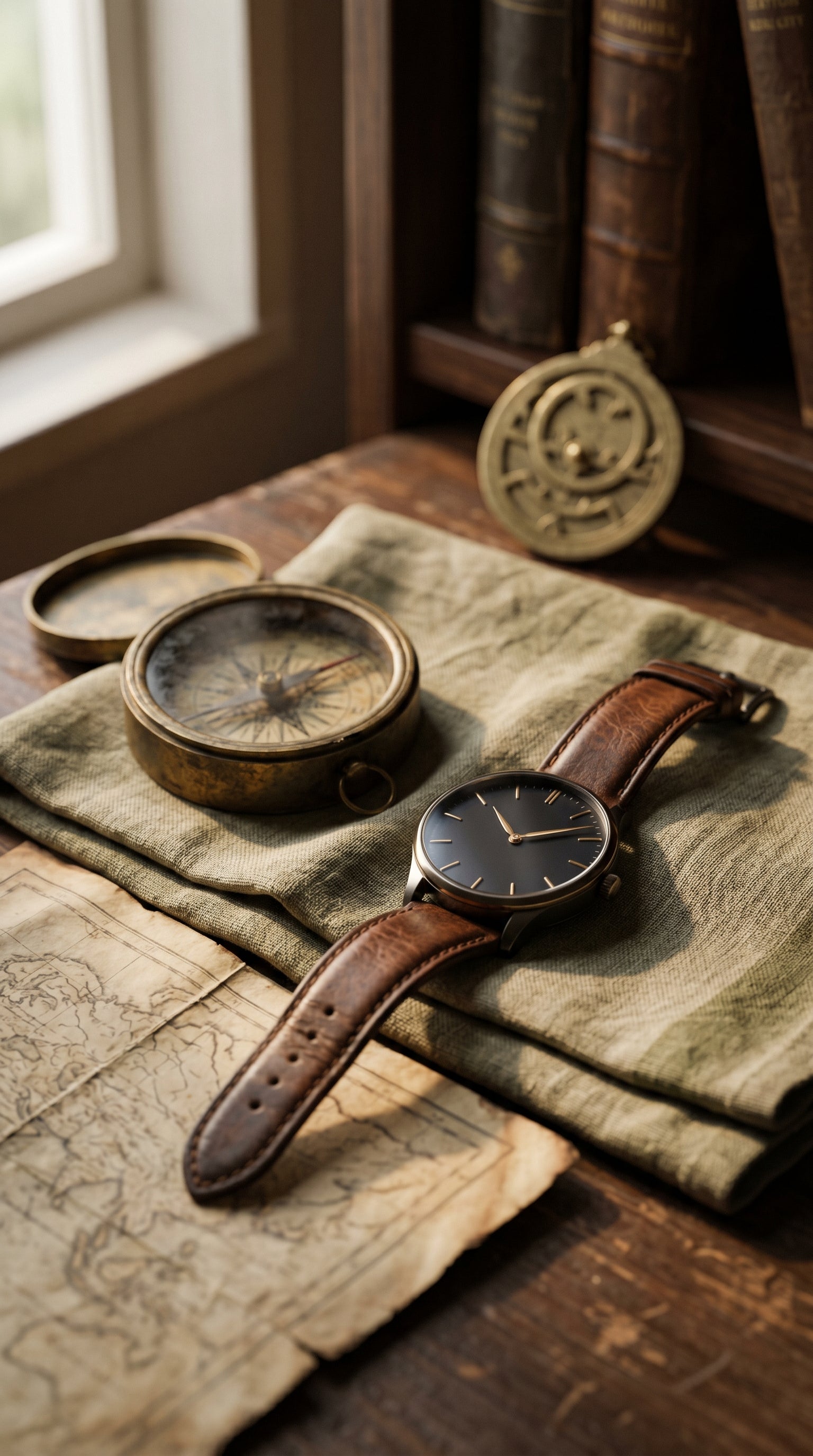
A regular compass points north. That’s a simple measurement of the Earth's magnetic field. But the Qibla doesn't point north; it points towards the Ka'ba, from wherever you are standing. And that direction is a calculation over the curvature of the earth, not a straight line on a map.
The Ka'ba is fixed. Mecca has one set of coordinates, as determined by Allah. But the direction in which you turn towards it changes with every step you take. From Amsterdam, the Qibla bends southeast. From Lagos, northeast. From Tokyo, westward. The same point, infinitely many directions.
MESSOUD combines a magnetic compass with the coordinates of Mecca, just as classical Muslim astronomers calculated it in the time of Al-Khwarizmi. You calibrate the watch once, and after that, the Qibla-finder points from your hotel room in Istanbul, your office in The Hague, your car on the highway.
No phone needed. No app to open. Just your wrist, and the direction to which every salah turns.
How it reminds you
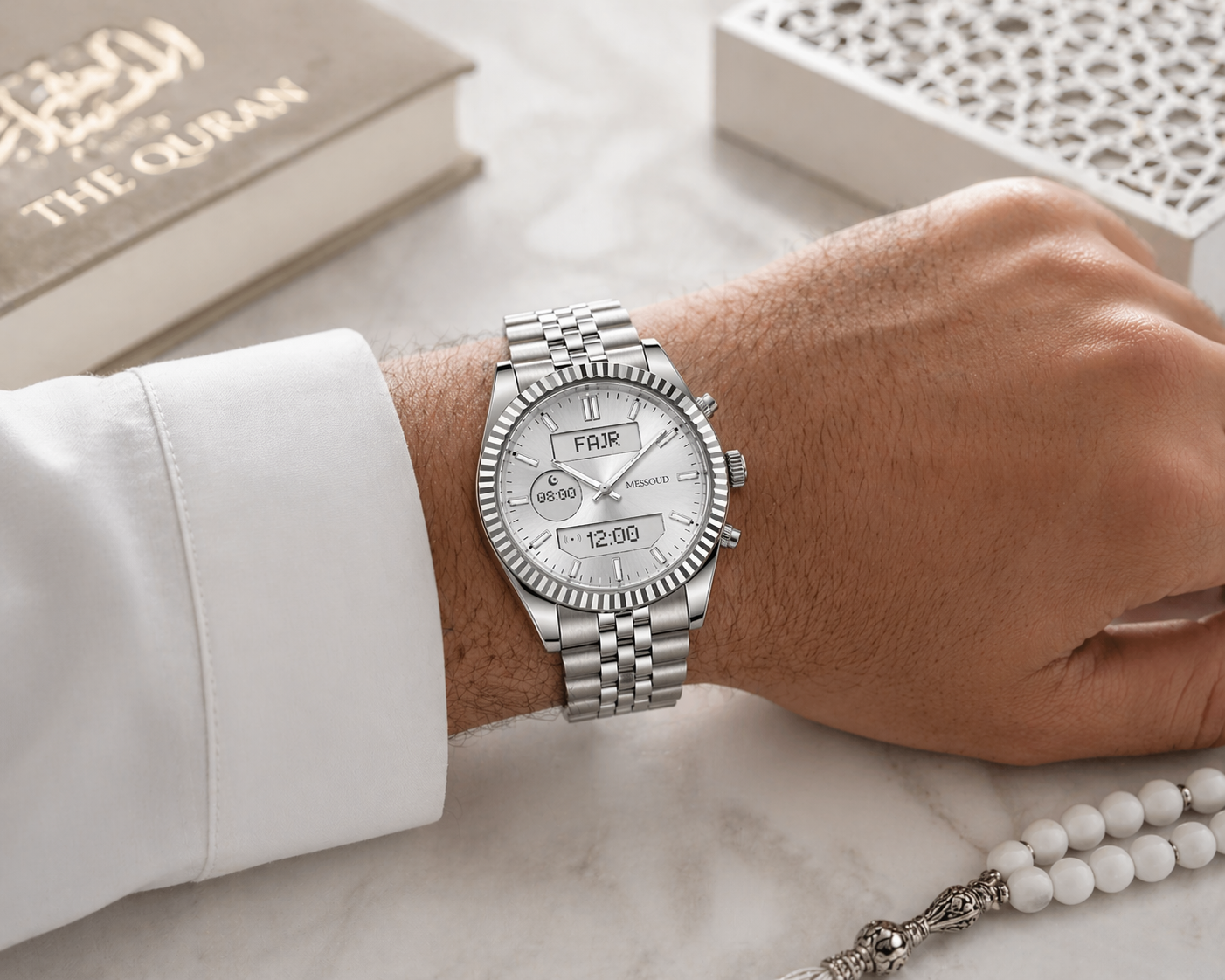
The Adhan is meant to be heard. Bilal ibn Rabah called it from the rooftops of Medina, and since then, that same call has rolled over every Muslim city in the world five times a day. But not every setting allows for that. A meeting, an office with colleagues, a train, an exam.
MESSOUD solves this with a short, clear tone, discreet enough for any setting, yet clear enough not to be missed. One tone for those who prefer subtlety, three for those who want a more emphatic call. You set it up.
No loud Adhan disturbing the world around you. No phone ringing among ten notifications. A reminder that no one around you needs to notice, but one you can't miss.
Discretion is not shame. It is adab towards those sitting next to you.
What MESSOUD is not
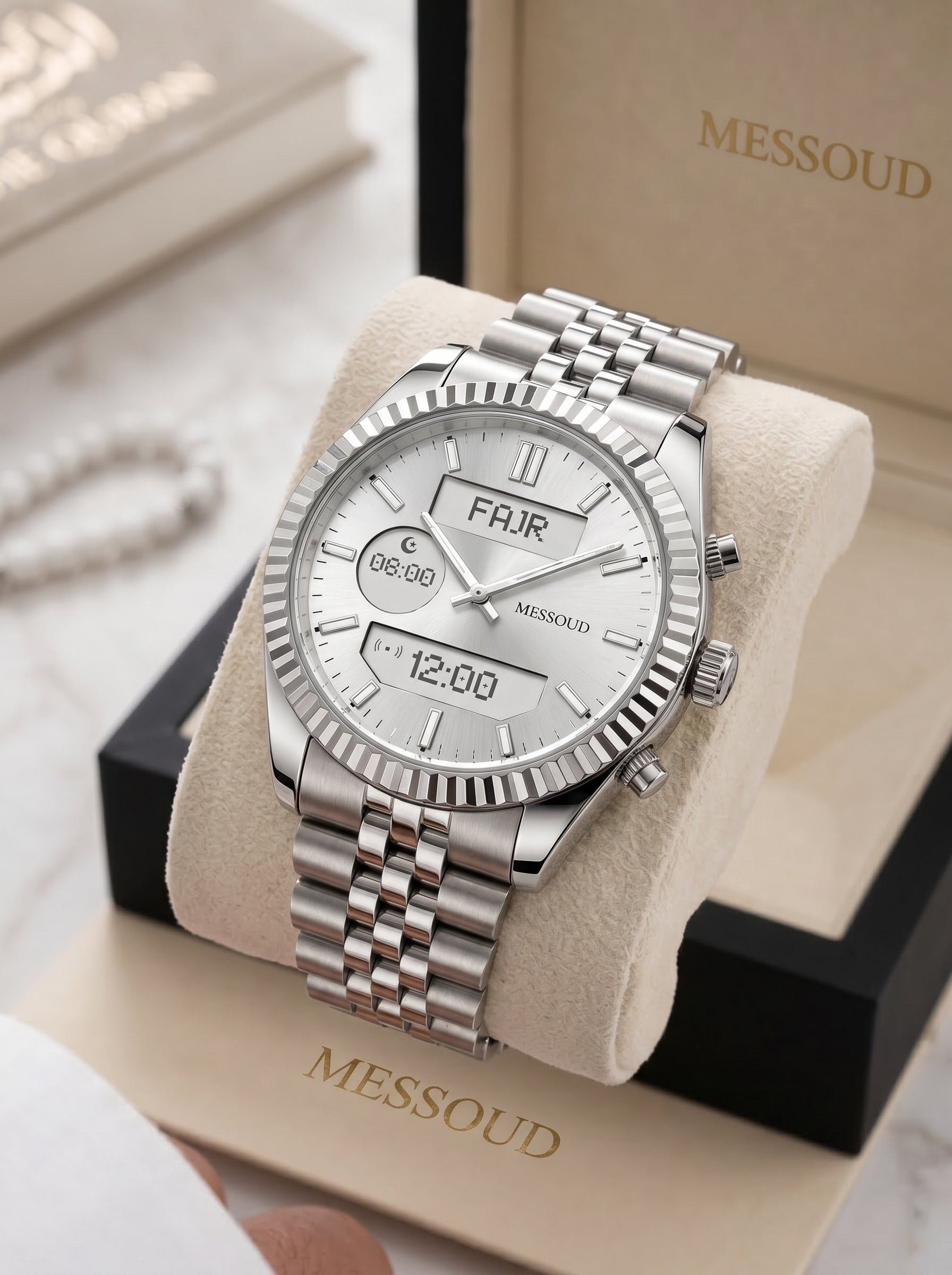
A MESSOUD is not a smartwatch. It doesn't measure your heart rate, count your steps, or read your messages. It doesn't connect to the cloud, require an account, or demand a subscription. There's no app you have to open every day, no software constantly asking for updates, no battery that needs charging every night.
What it does, it does completely: calculate prayer times, indicate the Qibla, keep track of the Hijri calendar, and remind you, five times a day, every day, without dependencies.
The watch you buy today will work exactly the same years from now. And decades from now.
Because the heavens don't change. And a watch that follows the heavens doesn't have to either.
How does the watch work?

Step 1
Set your location
Simply select your country and city. The watch will then automatically calculate prayer times based on your location.

Step 2
Set time and date
Enter your local time and date, so the watch can accurately align with your daily rhythm.

Step 3
Check prayer times
Compare the times with your local mosque and refine them if desired for maximum accuracy.

Step 4
Calibrate the Qibla Finder
Gently rotate the watch according to the instructions to correctly determine the Qibla direction.
Ready
Stay connected to your prayer
Receive automatic prayer reminders updated daily based on your set location.